
Vancouver Urbanism
The Vancouver
Paradox
How a globally celebrated model of "livable density" created one of the most exclusionary cities on earth.
The Model: "Vancouverism"
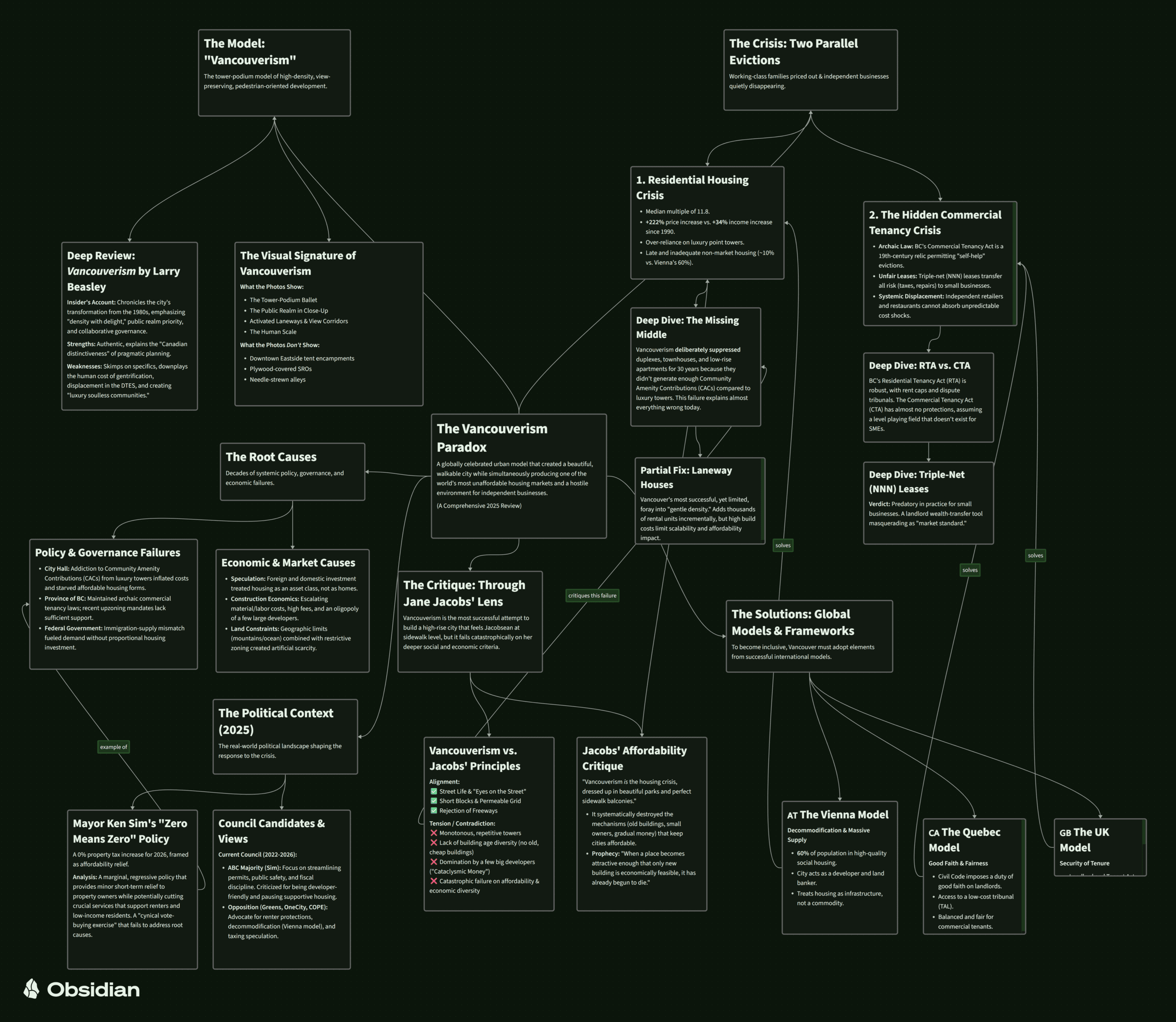
Thirty-five years ago, "Vancouverism" was hailed as the future of cities. Championed by planners like Larry Beasley, the model promised a rejection of the freeway-choked sprawl that defined North America. It offered a seductive alternative: high-density living that didn't sacrifice quality of life.
Core Principles (via Larry Beasley)
From Vancouverism (2019)
Density with Delight
Slender "point towers" (floor plates under 750 m²) spaced 25–30 meters apart to preserve light, air, and view corridors of the mountains and ocean.
The Podium Base
Towers sit on 3–4 storey podiums of townhouses or retail to maintain a human-scale "street wall," ensuring the pedestrian experience feels intimate, not overwhelming.
Public Realm
Over 20% of rezoned sites are dedicated to parks, plazas, and the famous seawall. The "win-win" ethos traded density bonuses for public amenities.
The Catalyst
Triggered by Expo 86, which cleared industrial waterfront lands (False Creek, Coal Harbour) for massive mixed-use redevelopment.
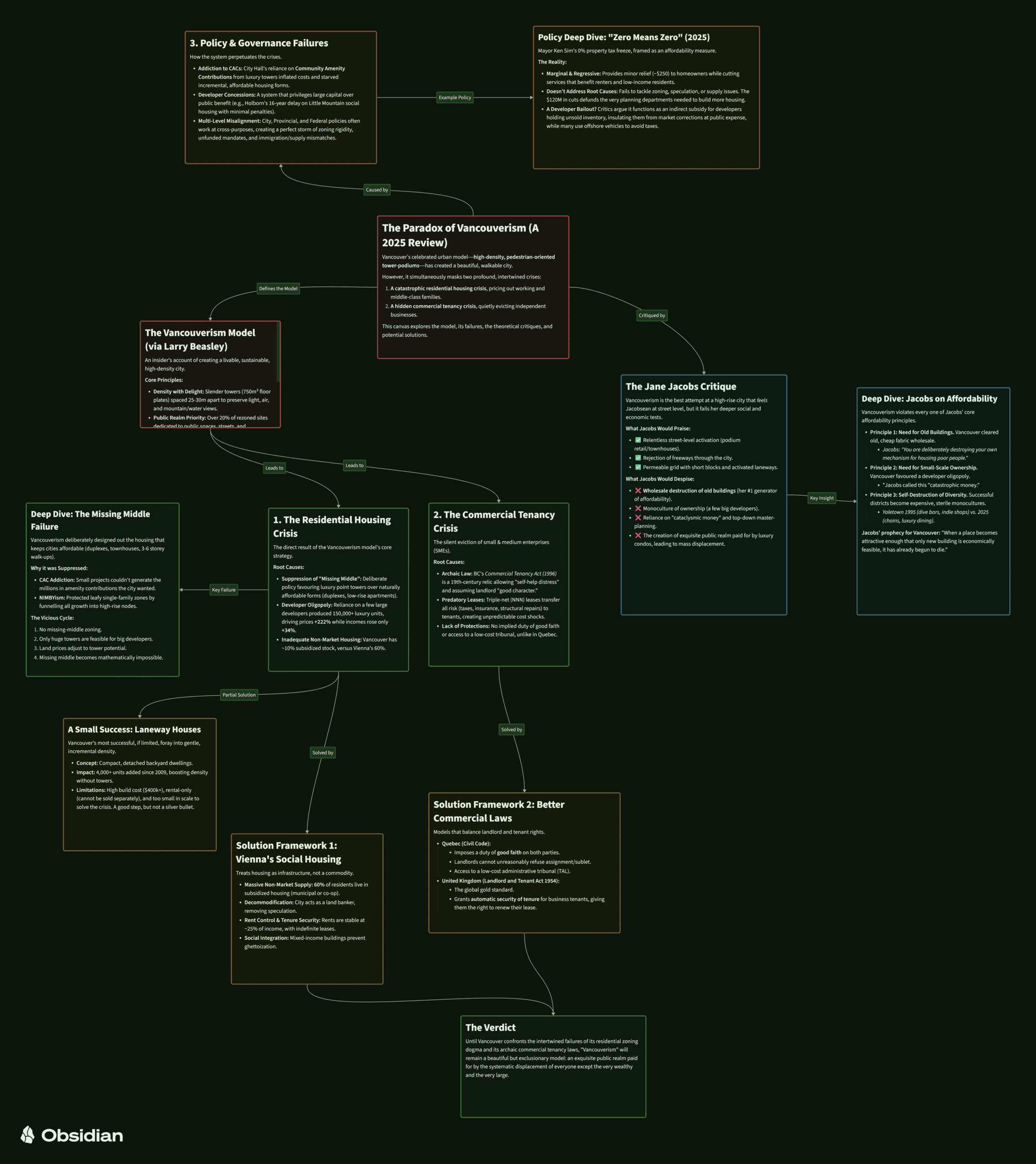
Visually, it is a triumph. But beneath the "delicious density" lies a structural failure. The glittering sidewalks now mask two parallel evictions: the working class family and the independent business.
The Residential Crisis
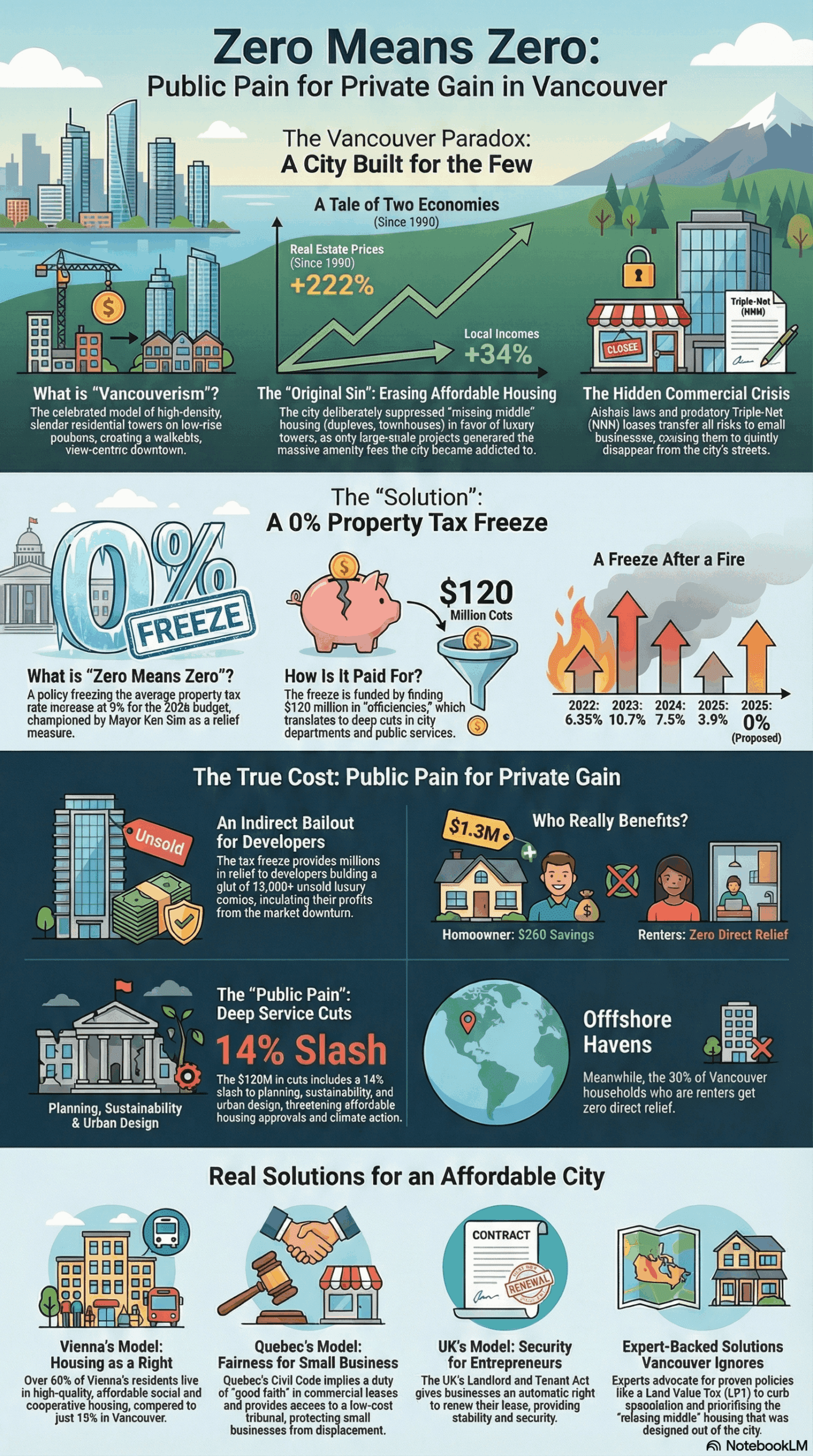
The housing affordability crisis is not an accidental byproduct; it is a feature of the model. Since 1990, Vancouver has produced over 150,000 units, yet prices have decoupled entirely from local incomes.
The "Original Sin": Missing Middle
For 30 years, city policy deliberately suppressed duplexes, townhouses, and low-rise walk-ups. Why? Because small projects couldn't generate the massive Community Amenity Contributions (CACs) that the city became addicted to extracting from luxury towers.
Developer Oligopoly
By relying on "market-driven" development for public benefits, the city favored a handful of large developers capable of financing massive projects. This produced luxury inventory ("global investment product") rather than local housing.
The Laneway Illusion
Laneway houses were Vancouver's most successful foray into "gentle density," adding thousands of units since 2009. However, with build costs soaring past $400k and restrictions on stratification (they cannot be sold separately), they remain a premium rental solution for homeowners rather than a path to ownership for the middle class.
The Hidden Commercial Crisis
While headlines focus on housing, a silent eviction is destroying the city's soul. Independent businesses are disappearing, replaced by chains that can absorb the shocks of Vancouver's predatory commercial leasing environment.
| Feature | Residential (RTA) | Commercial (CTA) |
|---|---|---|
| Rent Control | Capped annually (3%) | No caps. Unpredictable. |
| Eviction | 'Just Cause' only | Summary re-entry allowed. |
| Repairs | Landlord responsibility | Tenant pays 100% (Triple-net) |
Critique: Through Jacobs' Lens
Jane Jacobs, the legendary urbanist, argued that great cities need four generators of diversity. Vancouverism succeeds at the visual level—active sidewalks, short blocks—but fails catastrophically at the structural level.
1. Need for Old Buildings
Jacobs argued cities need old, cheap buildings to incubate new businesses and low-income residents. Vancouver cleared its old fabric (industrial lands, SROs) to build shiny glass towers, removing the "natural" affordability mechanism.
2. Small-Scale Ownership
She championed "gradual money"—thousands of small owners improving a city. Vancouverism relied on "cataclysmic money"—massive capital from a few developers reshaping entire neighborhoods overnight.
3. Self-Destruction of Diversity
"When a place becomes attractive enough that only new building is economically feasible, it has already begun to die." Vancouver's new districts have become "bedroom museums" for the wealthy.
"Zero Means Zero"
Mayor Ken Sim's 2026 property tax freeze. Framed as relief, analysis suggests it acts as a regressive measure and an indirect subsidy for developers holding unsold inventory.
Global Solutions
Vancouver does not need to reinvent the wheel. Successful international models offer a blueprint for fixing both the residential and commercial crises.
The Vienna Model
- Decommodification: 60% of residents live in non-market housing.
- Supply: The city acts as a land banker, removing speculation.
- Tenure: Indefinite leases create true housing security.
The UK Model
- Security of Tenure: Businesses have an automatic right to renew leases.
- Rent Disputes: Access to courts to determine fair market rent.
- Fairness: Prevents the "predatory" evictions seen in Vancouver.
The Final Verdict
Until Vancouver confronts the failures of its zoning dogma and archaic commercial laws, "Vancouverism" will remain a model of exclusion: exquisite public spaces paid for by the displacement of everyone except the very wealthy.
Story Background
Unique keys and personalities extraordinary to the journey.
Diary Dates: Truth Revealed
The System File Architecture (SFA) and DDNOTE system provide a structured and standardized approach to managing digital records. By integrating precise timestamping, AI-enhanced organization, and mnemonic categorization, this system ensures chronological accuracy, efficient data retrieval, and seamless collaboration. Learn how SFA and DDNOTE revolutionize digital file management, making it easier to track, search, and analyze historical data with confidence.
